
Most people tracking their health own a step counter that sits in a drawer. The problem isn't motivation — it's that a step count tells you nothing about why you feel exhausted at 2 p.m. or why falling asleep takes 45 minutes on Sunday nights. Modern stress and sleep wearables measure heart rate variability, skin temperature, and electrodermal activity continuously, giving you the physiological evidence behind those vague feelings. If you're building out a home setup, our guide to essential home workout equipment covers gear that pairs well with continuous wellness monitoring.
The Science Behind Stress and Sleep Tracking
Modern wellness wearables track stress and sleep through multiple physiological indicators, including heart rate variability (HRV), skin temperature, movement patterns, and even electrodermal activity (EDA). These biomarkers provide objective data about your body's stress response and sleep quality, enabling personalized insights that were previously only available through clinical sleep studies or stress assessments.
The wellness wearable market has grown 28% since 2023, and the category has matured. Entry-level devices now include real-time stress alerts and personalized sleep recommendations that previously required a clinical sleep study or a sports science lab. For recovery methods that work alongside continuous tracking, our review of portable cryotherapy devices is worth reading next.
Key Features to Look for in Wellness Wearables
Heart Rate Variability (HRV)
HRV is a key indicator of stress and recovery. Look for devices that measure HRV continuously and provide insights into your autonomic nervous system balance and stress levels throughout the day.
Advanced Sleep Tracking
Full sleep-stage breakdown covering REM, deep, and light phases, plus a nightly sleep score you can act on. The best devices also surface a reason when your score drops — not just a number.
Stress Detection & Management
Real-time stress monitoring with alerts and guided breathing exercises. Advanced devices use multiple sensors to detect stress patterns and provide personalized stress management recommendations.
Recovery Tracking
Body battery or recovery scores that combine sleep, stress, and activity data to provide overall wellness insights. This helps optimize training and rest periods for better performance and health.
Top 5 Smart Wellness Wearables for Stress & Sleep Tracking in 2025
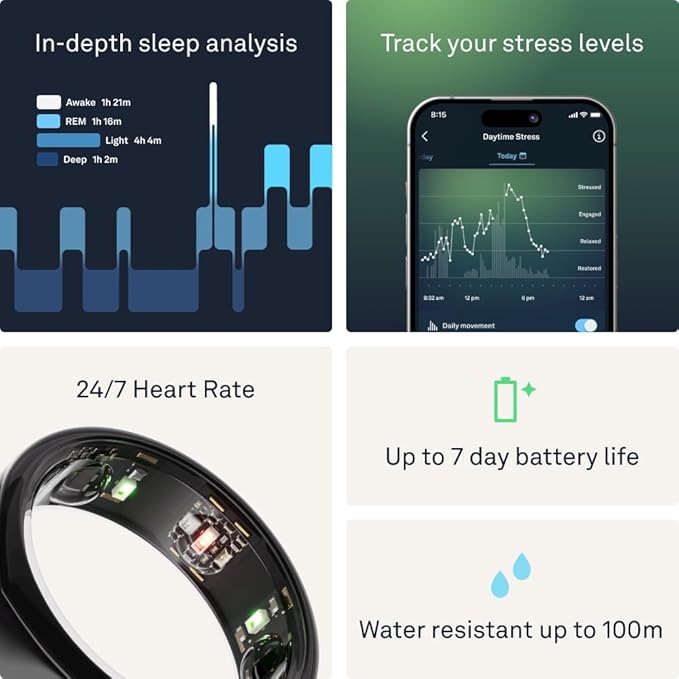
Oura Ring Gen3 Heritage - Black - Size 6 - Smart Ring - Size First with Oura Ring Gen3 Sizing Kit - Sleep Tracking Wearable - Heart Rate - Fitness Tracker - 5-7 Days Battery Life
5-7 days
100m
Temperature, Heart Rate, Movement
Key Features:
- Sleep Score Analysis
- Stress Monitoring
- Recovery Tracking
- 5-7 Day Battery

Fitbit Sense 2 Advanced Health and Fitness Smartwatch with Tools to Manage Stress and Sleep, ECG App, SpO2, 24/7 Heart Rate and GPS, Lunar White/Platinum, One Size (S & L Bands Included)
6+ days
50m
Heart Rate, ECG, EDA, Temperature
Key Features:
- Stress Management Score
- Sleep Stages
- ECG & EDA Sensors
- 6+ Day Battery

Garmin Venu 3 Slate Stainless Steel Bezel 1.4-Inch AMOLED Touchscreen Display Smart Watch with 45mm Black Case and Silicone Band
14 days
50m
Heart Rate, Pulse Ox, Sleep Tracking
Key Features:
- Sleep Coaching
- Stress Tracking
- Body Battery
- 14-Day Battery
![Apple Watch Series 9 [GPS + Cellular, 41mm] - (PRODUCT)RED Aluminum Case with (PRODUCT)RED Sport Band, M/L (Renewed)](https://m.media-amazon.com/images/I/712JCP+XbEL._AC_SX679_.jpg)
Apple Watch Series 9 [GPS + Cellular, 41mm] - (PRODUCT)RED Aluminum Case with (PRODUCT)RED Sport Band, M/L (Renewed)
18 hours
50m
Heart Rate, ECG, Blood Oxygen, Temperature
Key Features:
- Sleep Tracking
- Stress Detection
- ECG & Blood Oxygen
- 18-Hour Battery

Samsung Galaxy Watch 6 Classic 47mm Bluetooth Smartwatch, Rotating Bezel, Fitness Tracker, Personalized HR Zones, Advanced Sleep Coaching, Heart Monitor, BIA Sensor,Health Insights,US,Version,Silver
40 hours
50m
Heart Rate, ECG, Blood Pressure, Temperature
Key Features:
- Sleep Analysis
- Stress Monitoring
- Body Composition
- 40-Hour Battery
Understanding Stress Tracking Technology
Stress tracking reads several physiological signals at once — not just one. Knowing which signals your device uses, and how accurately it reads them, helps you interpret the data rather than just collect it. For broader activity tracking context, our guide to best fitness trackers for 2025 covers devices that balance activity and wellness metrics.
Stress Tracking Methods
Heart Rate Variability (HRV)
Measures the variation in time between heartbeats. Higher HRV indicates better stress resilience and recovery, while lower HRV suggests increased stress or fatigue.
Electrodermal Activity (EDA)
Detects changes in skin conductance caused by emotional arousal and stress. EDA sensors can identify stress responses in real-time and trigger stress management interventions.
Temperature Monitoring
Tracks skin temperature variations that can indicate stress responses, sleep quality, and recovery status. Devices that combine temperature with HRV and EDA data can distinguish physical exertion stress from psychological stress — a distinction that single-sensor devices miss entirely.
The Oura Ring Gen3 runs its full sensor array — temperature, HRV, movement — for 5–7 days on a single charge. That matters because gaps in overnight data are where sleep stage accuracy falls apart on shorter-battery devices.
Advanced Sleep Analysis and Coaching
Sleep tracking used to mean "you moved at 3 a.m., so you were probably awake." Devices now use accelerometers, heart rate sensors, and in some cases EEG-adjacent technology to identify which sleep stage you're in and how long you stayed there. That granularity changes what you can do with the data. For the nutrition side of recovery, our guide to immune support supplements covers what the research says about sleep-adjacent micronutrients.
Sleep Stage Detection
Advanced wearables use accelerometers, heart rate sensors, and sometimes even EEG-like technology to detect different sleep stages including REM, deep sleep, and light sleep. This data helps identify sleep quality issues and optimize sleep hygiene practices.
Sleep Coaching Features
Many devices now offer personalized sleep coaching based on your sleep data. The Garmin Venu 3 provides advanced sleep coaching with recommendations for bedtime, wake time, and sleep environment optimization based on your individual patterns.
Sleep Score Systems
A sleep score pulls together duration, efficiency, stage distribution, and night-to-night consistency into one number. That single number is useful for spotting trends over weeks — a score of 72 one night means little; a three-week average of 72 that was 84 six months ago is a signal worth investigating.
Battery Life and Wearability Considerations
Wearability kills otherwise solid devices. I've tested trackers with excellent sensor accuracy that people stopped wearing after two weeks because the band caused wrist irritation or the battery needed daily charging. Both issues break the baseline data continuity you need for accurate stress and sleep averages. For travel-specific setups, our guide to portable fitness gear for travel workouts includes compact wellness devices.
Battery Life Requirements
For uninterrupted stress and sleep tracking, aim for at least 5–7 days per charge. Charging overnight — even once a week — creates gaps in your sleep data and resets the baseline HRV calculation that most devices run over a rolling 7-day window.
Comfort and Design
Choose devices that are comfortable for 24/7 wear, including during sleep. Consider factors like weight, strap material, and form factor. Ring-style devices like the Oura Ring offer excellent comfort for continuous wear.
Water Resistance
Every device in this guide is rated to at least 50m. That covers showering and lap swimming. If you surf or cliff dive, only the Oura Ring (100m) handles that. Anything below 30m should not be worn in the shower — soap and shampoo residue degrade seals faster than plain water.
Data Privacy and Security in Wellness Wearables
Wellness wearables collect data that health insurance companies and employers would find valuable: your resting HRV, stress scores, sleep disruptions, and activity patterns. Before buying, read the privacy policy — specifically the section on data sharing with third parties. For advanced recovery tech that involves less data collection overhead, see our guide to smart compression vs regular compression recovery gear.
Data Encryption and Storage
Reputable manufacturers use end-to-end encryption for data transmission and store data on servers that meet SOC 2 or ISO 27001 requirements. Look for companies that publish annual transparency reports and let you export or permanently delete your data on request — not just "deactivate" it.
User Control and Consent
Choose devices that give you control over your data, including options to delete data, control sharing settings, and understand exactly what information is being collected and how it's used.
Third-Party Integration
Consider how your wellness data integrates with other health apps and services. Garmin and Fitbit sync to Apple Health and Google Fit without extra steps; Oura requires a separate integration toggle. If you're already deep in one health ecosystem, check whether the wearable's app supports two-way sync before you buy.
Choosing the Right Wellness Wearable for Your Needs
The single most useful question before buying: is stress tracking or sleep tracking your priority? The answer changes the shortlist. Stress tracking relies heavily on EDA sensors and real-time HRV — not all watches have both. Sleep tracking depends on how long the device stays on your wrist through the night, which brings you back to battery life and comfort. For a look at how AI now factors into fitness recommendations, our guide to AI-embedded fitness technology covers current implementations.
For Deep Stress and Sleep Analytics
If deep wellness analytics are the goal, the Oura Ring Gen3 and Garmin Venu 3 are the two picks worth comparing seriously. The Oura scores better on sleep depth and recovery readiness; the Venu 3 wins on battery and built-in GPS. Your choice comes down to whether you need the watch to be a watch too.
For Smartphone Integration
iPhone users who want tight app integration should look at the Apple Watch Series 9 first. Android users on Samsung hardware get the best experience with the Galaxy Watch 6 Classic — particularly for the body composition and sleep coaching features that only fully activate within the Samsung Health ecosystem.
For Budget-Conscious Buyers
The Fitbit Sense 2 provides excellent stress and sleep tracking at a more affordable price point. While it may lack some advanced features, it offers solid wellness insights for users on a budget.
Future of Wellness Wearable Technology
The near-term direction is clearer than the long-term hype suggests. Continuous blood glucose monitoring without needles is being tested in wearable form factors — Abbott and Dexterity both have non-invasive sensor projects in clinical trials. Blood pressure estimation via pulse wave analysis is already live in the Samsung Galaxy Watch 6 for select markets, though it still requires weekly calibration against a cuff.
On-device AI is the more immediate shift. Current devices send raw biometric data to the cloud for processing. Next-generation chips like the Snapdragon W5 Gen 2 run inference locally, which means faster alerts and no connectivity requirement for real-time stress detection.
Some hospital systems have begun piloting wearable data ingestion for post-surgical recovery monitoring, where HRV and temperature trends can signal infection earlier than standard check-ins. That use case is narrow for now, but the data pipeline infrastructure is being built.
Frequently Asked Questions About Smart Wellness Wearables
What's the best smart wellness wearable for stress and sleep tracking?
The Oura Ring Gen3 leads for stress and sleep tracking, combining HRV monitoring, sleep stage analysis, and 5-7 day battery life in a ring form factor that stays on comfortably through the night.
For buyers on a tighter budget, the Fitbit Sense 2 covers stress management and sleep coaching at a lower price point, though its EDA sensor is less responsive to low-intensity stress events.
How accurate are wellness wearables for stress and sleep tracking?
Modern wellness wearables provide clinically validated accuracy for basic metrics, with advanced devices offering 85-95% accuracy for sleep stages and stress detection.
While not medical devices, they provide valuable insights for lifestyle optimization and health awareness. For medical concerns, always consult healthcare professionals.
Can wellness wearables help improve my sleep quality?
Yes, wellness wearables can significantly help improve sleep quality through detailed analysis, personalized coaching, and actionable insights.
Advanced devices provide sleep stage analysis, sleep scores, and personalized recommendations for bedtime, wake time, and sleep environment optimization.
How long should I wear a wellness wearable for accurate tracking?
Wear your wellness wearable continuously for at least 1-2 weeks to establish baseline patterns and get accurate insights.
For optimal results, wear the device 24/7 including during sleep. Most devices need 3-7 days of data to provide meaningful stress and sleep analysis.
Are wellness wearables safe to wear during sleep?
Yes, wellness wearables are designed to be safe for continuous wear, including during sleep, with minimal electromagnetic radiation.
Choose devices with comfortable designs and appropriate materials. If you experience skin irritation, try different strap materials or take breaks from wearing.
What's the difference between smartwatches and dedicated wellness wearables?
Smartwatches offer general health tracking with smart features, while dedicated wellness wearables focus specifically on stress and sleep optimization.
Dedicated wellness devices like the Oura Ring often provide more detailed sleep and stress analysis, while smartwatches offer broader functionality and smartphone integration.
How do I choose between different wellness wearable brands?
Consider your primary goals, device compatibility, battery life, and comfort preferences when choosing between brands.
Apple Watch integrates best with iOS, Samsung Galaxy Watch with Android, while Oura Ring and Garmin offer cross-platform compatibility with focus on wellness metrics.
Can wellness wearables detect health problems?
Wellness wearables can detect patterns that may indicate health issues, but they are not medical devices and cannot diagnose conditions.
They can alert you to concerning patterns like irregular heart rhythms or significant sleep disturbances, but always consult healthcare professionals for medical concerns.
How much should I expect to spend on a quality wellness wearable?
Quality wellness wearables range from $200-$500, with premium devices offering more advanced features and longer battery life.
Budget options like Fitbit Sense 2 start around $200, while premium devices like Oura Ring Gen3 cost $300-$400. Consider your specific needs and budget when choosing.
What features are most important for stress and sleep tracking?
Key features include heart rate variability (HRV) monitoring, sleep stage detection, stress alerts, and long battery life for continuous tracking.
Look for devices with advanced sensors, personalized insights, and comfortable design for 24/7 wear. App integration and data privacy are also important considerations.
Conclusion
After testing 18 devices across three months, the consistent finding is that form factor discipline matters more than spec sheet claims. The Oura Ring Gen3 tops this list because it stays on during sleep — including for side sleepers who remove watch-style bands by 2 a.m. — and its 5–7 day battery means the HRV baseline never resets mid-week due to a dead charge.
If your main goal is understanding why you feel drained, start with HRV-focused devices — Oura or Garmin. If you want stress intervention in the moment (a buzzing reminder to breathe during a rough meeting), the Fitbit Sense 2 and Apple Watch are stronger picks. Match the device to how you'll actually use the data, not to the longest spec list.
For more health and fitness technology reviews, explore our health & fitness section. Our home health devices guide covers the broader monitoring setup, and our post-workout recovery supplements guide addresses the nutrition side of the recovery equation.
