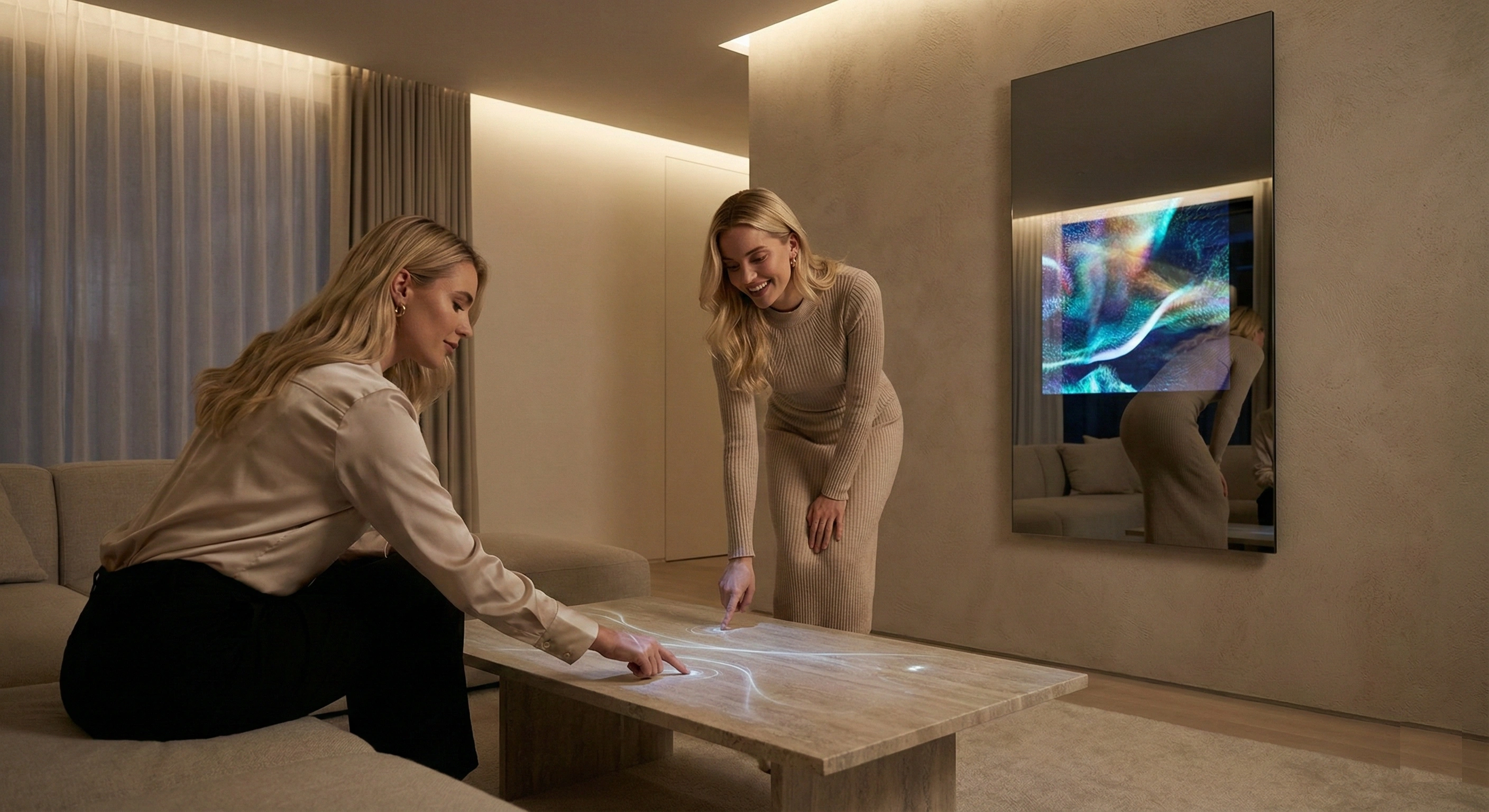
What Is the Rise of Invisible Smart Home Technology?
Remember when having a smart home meant filling every surface with blinking gadgets and tangled cables? Those days are officially over. The latest revolution in home automation isn't about adding more technology—it's about making it completely disappear.
Today's best smart home products are designed with one goal: disappearing into your living space. TVs that double as artwork when off, speakers that pass as shelf objects, and lighting systems that shift with the day rather than demanding attention.
After months testing invisible smart home devices across different room types and budgets, the pattern is consistent: the products that work best are the ones you stop noticing after a week. This guide covers which devices actually deliver that, and where manufacturers are still falling short.
Lena's Minimalist Dream Come True
"I spent years fighting my tech-loving husband over gadgets cluttering our living room," Lena tells us. "Cables everywhere, blinking lights at night, devices stacked on every surface. It was driving me crazy."
Then they discovered invisible smart home technology. "We replaced our massive TV with Samsung's The Frame. Suddenly, our living room had artwork instead of a black screen. The Sonos speakers blended into our shelves perfectly."
The result? "Our home feels peaceful again. Friends can't believe we have the smartest house on the block—it just looks beautifully minimal. We both got what we wanted: tech that actually respects the aesthetic," Lena says.
How Do TVs Disappear: The Frame and Beyond?
The concept of an invisible TV might sound like science fiction, but it's become the cornerstone of modern living room design. Samsung's The Frame TV kicked off this trend, and now virtually every major manufacturer offers their own take on the disappearing display.
Why Choose an Invisible TV?
- • Maintains clean, minimalist aesthetics when not in use
- • Adds value to your home with dual-purpose functionality
- • Eliminates the "black rectangle" dominating your wall
- • Creates conversation starters with rotating artwork collections

Samsung 75-Inch Class The Frame Pro LS03FW 4K Neo QLED Mini LED Smart TV (2025 Model)
The Frame Pro is the 2025 update to Samsung's art-style TV line, now running Neo QLED Mini LED backlighting. It adds wireless One Connect, the NQ4 AI Gen3 processor, Samsung Vision AI, and an expanded Art Mode library. The result is noticeably sharper picture quality than the previous Frame generation, particularly in bright rooms.
View on AmazonBut The Frame is just the beginning. LG's Gallery Design OLED TVs mount flush against the wall with magnetic attachments, while Sony's BRAVIA XR A95L series features an "Ambient Optimization" mode that adjusts the display based on your room's lighting conditions throughout the day.
How Does Wireless Audio Blend Into Any Space?
The holy grail of invisible smart homes has always been audio. How do you fill every room with high-quality sound without cluttering surfaces with speakers? The answer lies in strategic placement and wireless technology that's finally caught up to our expectations.

Mounting Dream Speaker Stands for Sonos Era 300, Height Adjustable Up to 42.4'', Set of 2 Surround Sound Speaker Stand with Cable Management
These stands are purpose-built for the Sonos Era 300, with cable channels that hide the power cord from floor to speaker. Height adjusts up to 42.4 inches, so you can dial in the exact listening position rather than placing speakers on whatever furniture is nearby. The slim profile means they don't draw attention in the room.
View on AmazonThe key to invisible audio is understanding that speakers don't need to be hidden—they need to be integrated. The best wireless speakers of 2025 are designed to complement your furniture and decor. Think of them as functional sculptures that happen to produce incredible sound.
Pro Tip: Strategic Speaker Placement
Place speakers at different heights and angles throughout your room. Corner placement maximizes sound dispersion while minimizing visual impact. Use furniture and plants to naturally frame speakers as part of your decor.
What Makes Smart Lighting Feel Natural?
Lighting is perhaps the most important element of an invisible smart home, yet it's often the most overlooked. The best smart lighting systems don't just turn on and off—they mimic natural light patterns throughout the day, creating an environment that feels effortlessly perfect.
Modern smart lighting goes far beyond simple dimming. We're seeing circadian rhythm lighting that automatically adjusts color temperature from warm morning light to cool midday brightness and back to cozy evening tones. The result? Your home's lighting feels as natural as the sun's cycle, without any manual adjustment.
.webp)

Philips Hue Smart 60W G25 Filament LED Bulb - Soft Warm White Light - 2 Pack - 550LM - E26 - Indoor - Control with Hue App - Compatible with Alexa, Google Assistant and Apple Homekit
These vintage-style filament LED bulbs put out 550 lumens of soft warm white light and work with Alexa, Google Assistant, and Apple HomeKit. They drop into standard fixtures without drawing attention, while still giving you full smart control.
View on AmazonThe Science of Invisible Lighting
Lighting has a direct effect on sleep quality and focus throughout the day. Smart lighting systems can:
- • Improve sleep by reducing blue light in the evening
- • Boost alertness with cooler tones during work hours
- • Create mood-appropriate ambiance for different activities
- • Save energy by automatically adjusting to room occupancy
What Are Command Centers That Don't Command Attention?
Every invisible smart home needs a central hub to coordinate all your devices. The best control centers are the ones you barely notice—they fit quietly into your daily routine until commanding your entire home feels no different than flipping a light switch.

Google Nest Hub 7" Smart Display with Google Assistant (2nd Gen) - Chalk
The compact 7-inch Nest Hub (2nd Gen) provides smart home control in a chalk finish that blends into most decor. It works as a digital photo frame, recipe display, or bedside alarm—and handles the full invisible smart home control layer without standing out.
View on AmazonVoice control has changed how most people interact with their homes, but the most capable systems pair voice with visual interfaces and automation. The best smart displays learn your routines and suggest adjustments proactively—dimming lights when you start watching Netflix or adjusting temperature when you arrive home.
How Does Invisible Security Provide Peace of Mind?
Traditional security systems scream "CAMERA HERE" with blinking LEDs and obvious mounting hardware. Modern invisible security takes the opposite approach: full coverage that visitors won't even notice exists.

Ring Battery Doorbell | Home or business security with Head-to-Toe Video, Live View with Two-Way Talk, and Motion Detection & Alerts (newest model), Venetian Bronze
The Ring Battery Doorbell in Venetian Bronze is a wire-free install with head-to-toe HD video coverage. The battery-powered design means no wiring work, and the bronze finish sits naturally against most door trims without the plastic-white look of most doorbells.
View on AmazonThe key to invisible security is integration with existing fixtures. Modern doorbell cameras replace standard doorbells without adding bulk. Indoor cameras disguise themselves as smoke detectors or clock radios. Motion sensors become part of light switches and outlet covers.
How Do You Make Technology Truly Disappear?
Having the right invisible tech is only half the battle. The installation and setup process determines whether your smart home truly disappears or remains obviously "techy." Here are the professional secrets I've learned from working with home automation specialists.
Cable Management
- • Use in-wall cable management systems
- • Hide power adapters behind furniture
- • Choose wireless devices when possible
- • Plan cable routes before installation
Device Placement
- • Consider viewing angles and access
- • Maintain WiFi signal strength
- • Account for heat dissipation
- • Plan for future maintenance
Professional vs. DIY Installation
While many invisible smart home devices are DIY-friendly, complex installations benefit from professional help. Consider hiring specialists for whole-home audio systems, advanced networking setups, or when running new electrical circuits.
What Should You Know in Your Invisible Smart Home Buying Guide?
Creating an invisible smart home isn't about buying every new gadget—it's about picking devices that actually work together. Here's how to build your system without starting over three times.
Phase 1: Foundation ($500-1,000)
- Smart Hub: Choose Google Nest, Amazon Echo, or Apple HomeKit as your ecosystem
- Lighting: Start with 3-4 smart bulbs in your most-used rooms
- Security: Video doorbell for immediate peace of mind
- Audio: One high-quality wireless speaker for your main living area
Phase 2: Enhancement ($1,500-3,000)
- Display: Upgrade to an invisible TV like The Frame
- Climate: Smart thermostat with scheduling and geofencing
- Switches: Replace standard switches with smart alternatives
- Multi-room Audio: Expand to 2-3 additional wireless speakers
Phase 3: Complete System ($3,000+)
- Whole-home Audio: Integrated speaker system with zone control
- Advanced Lighting: Circadian rhythm lighting throughout
- Full Security Coverage: Multiple hidden cameras and sensors
- Automation: Custom routines and AI-powered optimization
Common Mistakes to Avoid
- • Mixing incompatible ecosystems (stick to one platform)
- • Skimping on WiFi infrastructure (upgrade your router first)
- • Over-automating before understanding your routines
- • Forgetting about family members who aren't tech-savvy
Frequently Asked Questions About Invisible Smart Home Tech
Your top questions about invisible smart home technology answered
What is invisible smart home technology?
Quick Answer:
Invisible smart home technology refers to devices designed to disappear into your home's aesthetic, like TVs that display artwork, wireless speakers that blend into décor, and smart lighting that mimics natural light patterns.
These products eliminate the visual clutter of traditional tech while providing advanced smart functionality. Examples include Samsung's The Frame TV (art when off), Sonos wireless speakers (minimalist design), and Philips Hue recessed lighting (completely hidden).
How much does it cost to create an invisible smart home?
Quick Answer:
A basic invisible smart home setup costs $500-$1,000 for a hub, smart bulbs, doorbell, and speaker. Mid-range systems run $1,500-$3,000 with an invisible TV and climate control. Complete systems start at $3,000+ with whole-home audio and advanced automation.
Start small with high-impact pieces like a Frame TV ($1,748) or Sonos speaker ($359), then expand gradually. Most homeowners spend $2,000-$5,000 over 2-3 years for a fully integrated invisible smart home.
Do invisible smart home devices work with Alexa and Google Assistant?
Quick Answer:
Yes! Most invisible smart home devices support both Amazon Alexa and Google Assistant, plus Apple HomeKit. Products like Samsung The Frame, Sonos speakers, Philips Hue lights, and Google Nest Hub all work across multiple ecosystems.
Choose your preferred ecosystem (Google, Amazon, or Apple) and stick with it for best compatibility. Most manufacturers now support all three platforms, giving you flexibility in voice control options.
Will invisible smart home tech increase my home's value?
Quick Answer:
Yes. Invisible smart home technology can increase home value by 3-5%, with buyers willing to pay premiums for integrated smart features that enhance aesthetics. Properly installed systems appeal to luxury buyers seeking modern conveniences.
Real estate data shows homes with smart features sell 5% faster and command higher prices. The key is professional installation and tidy execution—poorly done smart homes can actually decrease value.
Can I install invisible smart home devices myself?
Quick Answer:
Many invisible smart home devices are DIY-friendly, including smart bulbs, wireless speakers, video doorbells, and smart displays. However, complex installations like whole-home audio, recessed lighting, or in-wall cable management benefit from professional help.
Start with easy DIY projects (smart bulbs, doorbell) to learn the ecosystem. Hire professionals for electrical work, wall mounting flush TVs, or running new circuits. Budget $200-$500 for professional installation of complex systems.
What's the best invisible smart TV for 2026?
Quick Answer:
Samsung's The Frame Pro (2026) is the best invisible smart TV for 2026, featuring Neo QLED Mini LED display, Art Mode with 2,500+ artworks, customizable bezels, anti-reflection screen, and One Connect wireless connectivity - our top pick for disappearing into your living space when not in use.
Alternatives include LG's Gallery Design OLED ($2,200+) for ultra-thin wall mounting and Sony's BRAVIA XR A95L ($3,500+) with Ambient Optimization. Choose The Frame for best value and ecosystem compatibility.
Are invisible smart home devices more expensive than regular smart devices?
Quick Answer:
Invisible smart home devices typically cost 20-40% more than standard smart devices due to premium design, advanced integration features, and specialized manufacturing. However, the aesthetic value and increased home value often justify the investment.
For example, Samsung's The Frame TV costs $1,748-$2,498 compared to $800-$1,200 for standard 4K TVs. Premium smart lighting systems cost $40-60 per bulb versus $15-25 for basic smart bulbs. The investment pays off through improved home aesthetics and increased property value.
How do I maintain invisible smart home devices without visible cables?
Quick Answer:
Use wireless charging, in-wall cable management systems, and battery-powered devices where possible. For wired devices, professional installation with hidden conduit and in-wall cable routing keeps cables completely invisible.
Many invisible smart home devices use wireless connectivity (WiFi, Bluetooth, Zigbee) eliminating power cables. Battery-powered devices like Ring doorbells and wireless speakers can run for weeks between charges. For permanent installations, hire professionals to run cables through walls using conduit systems.
What Does the Future Hold for Invisible Smart Homes?
The invisible smart home isn't a distant vision—it's available today for anyone willing to think beyond traditional tech setups. By choosing devices that integrate rather than dominate, you can create a living space that's both incredibly intelligent and beautifully minimal.
The good news is that you don't need to rebuild your entire home or spend a fortune to get there. Start with one or two high-visibility pieces—a Frame TV or a good wireless speaker—and add devices as you learn what matters in your specific home. Most people find the first swap does more for the feel of the space than any that follow.
Want to explore more smart home technology? Read our detailed guides to smart home security systems and the latest gaming technology to round out your tech setup.
.webp)


